
Reviewed and updated: November 10, 2026
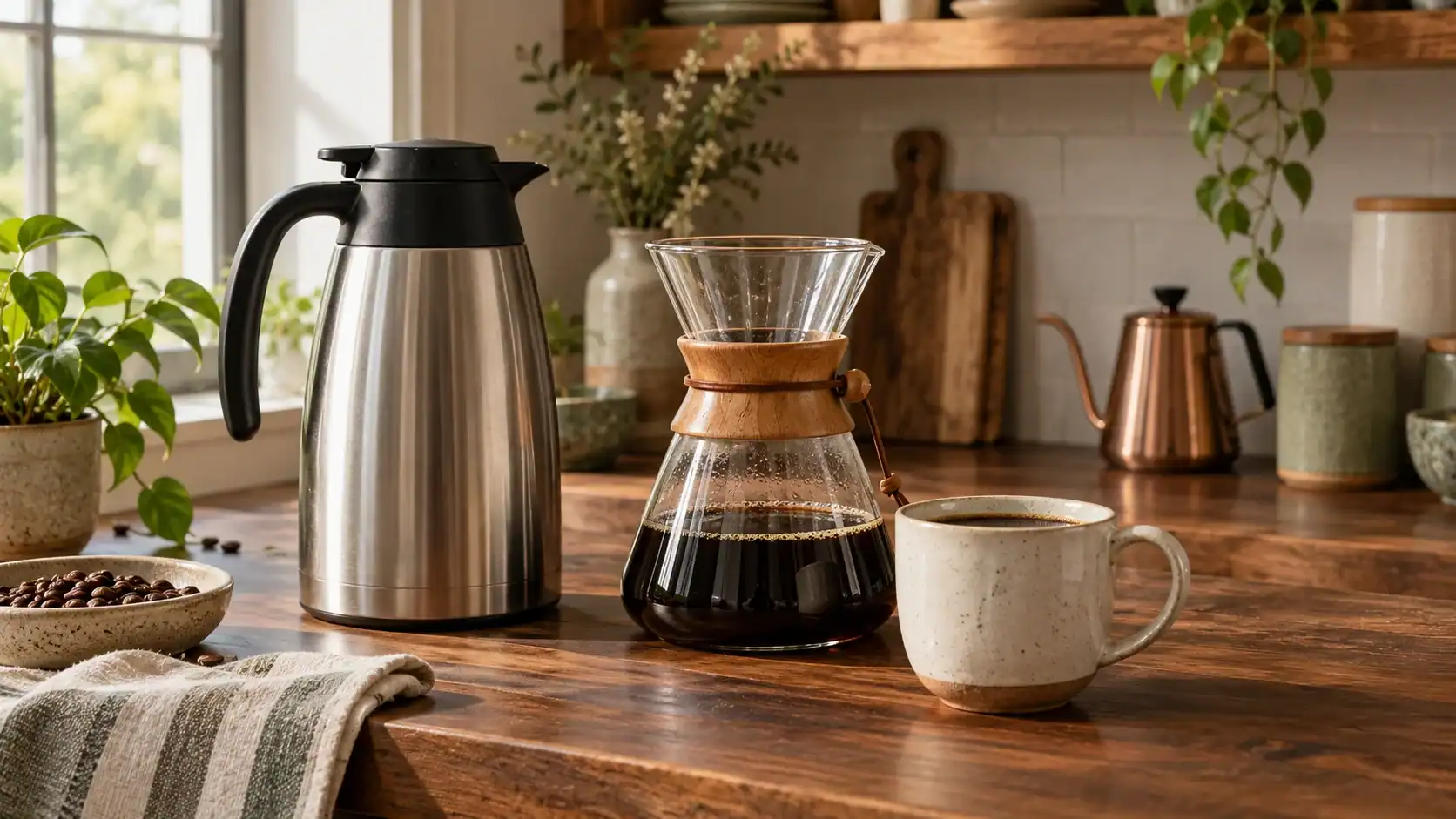
We recommend the one-liter Zojirushi SH-HC10 stainless steel vacuum carafe if you want to serve a shared batch later without leaving it on a warming plate. Choose the 600-milliliter Hario V60 Clear Range Server when you want a visible, smaller batch that you will pour soon. Zojirushi’s main compromise is its stopper: insulation and lever pouring add parts to clean, and the carafe must remain upright rather than become a sealed travel container.
The useful distinction is holding coffee versus simply serving it. A clear glass server can be the better companion to a small pour-over even though it lacks vacuum insulation. We would choose around when you finish the batch and where you serve it, then compare capacity and care instead of buying the largest carafe you can find.
The SH-HC10 uses a stainless steel vacuum-insulated body and a lever-operated pour. We would choose that combination when you want to bring coffee to a table and serve it over a longer breakfast, rather than keep returning to a powered warming plate. The one-liter capacity gives you room for a modest shared batch without committing to a large event dispenser.
One liter is roughly 34 fluid ounces. With 10-ounce mugs, think of approximately three servings with some room left, not a promise of a dozen large coffees. If you normally brew a much smaller amount, a 600-milliliter server may be the more comfortable size to handle. Capacity should follow the batch you actually want to hold.
The stopper can be removed and disassembled for cleaning. That is useful access, while also being work you need to be willing to do. Coffee passes through more than an open glass rim: the stopper, valve and packings need the care specified in the instructions. We would choose a simpler server if avoiding those extra parts is more important than holding temperature.
The 600-milliliter V60 Clear Range Server is our glass alternative when seeing the coffee and serving a smaller amount matter most. Hario identifies the body and lid as heatproof borosilicate glass, with a silicone lid gasket. You get a handled pouring vessel and a visible drink level without the insulated carafe’s lever-and-stopper arrangement.
We would choose this direction for coffee you expect to divide between cups soon after brewing. Its 600-milliliter capacity is about 20 fluid ounces, so it suits a modest shared serving rather than a large household batch. Leave practical pouring room instead of buying on the assumption that the maximum stated volume is the amount you should fill to the rim.
The tradeoff is that this is a glass server, not a vacuum-insulated holding vessel. If your second cup usually happens much later, the Zojirushi is the more relevant design. If everyone pours at once, the added stopper mechanism may bring little benefit compared with the glass server’s simpler, visible format.
With glass, you can judge the remaining coffee at a glance. An opaque insulated carafe asks you to keep track of what has been served. If several people help themselves, that visibility can be a useful everyday advantage of the smaller Hario, even when insulation initially seems like the more impressive feature.
Measure the coffee you normally prepare before choosing a carafe. A brewer’s cup marking can represent a much smaller serving than your usual mug, so a capacity described only in cups is easy to misread. Milliliters or fluid ounces make the comparison clearer, especially if milk takes up part of the final drink.
We would also think about whether everyone drinks the same coffee. A holding carafe is useful for a shared batch, while a household making several different individual drinks may not need one. Buying a large vessel to store leftovers can add cleaning and counter space without making the next drink more convenient.
If you are choosing an entire automatic brewer rather than a separate serving vessel, our thermal-versus-glass OXO comparison explains how a carafe and the machine’s heating arrangement work together. That is a different purchase from buying a stand-alone server to use with coffee you already make.
We would not substitute either product for a broken automatic-brewer carafe without explicit compatibility. Height, lid shape, basket clearance and any drip-stop interface can determine whether the machine works safely. Matching the approximate capacity does not establish that a new vessel belongs beneath a particular brewer.
The same care applies when you plan to put a manual dripper directly on a server. Check the opening, support and compatibility of the actual pieces you intend to combine. A photo of one dripper on one carafe does not establish that every brewing accessory fits equally securely. You want stable support before hot water and coffee are involved.
For serving at a table, allow space around the handle and room to pour into your normal cup. A larger carafe becomes heavier when filled, and a high shelf or cramped counter can make handling awkward. We would favor the size you can comfortably use rather than treat spare capacity as a reason to buy a larger version automatically.
Hario lists this Clear Range Server as microwave-safe with or without its lid. That is useful if reheating a small amount is part of your routine, while the glass still needs careful handling. Do not transfer that permission to a steel vacuum carafe, a different lid or another server simply because it is sold for coffee.
The Zojirushi instructions require upright handling and warn against carrying it on its side or placing it filled inside a moving vehicle. We would choose it for a table or stationary coffee station, rather than expect a lever-operated carafe to replace a sealed travel bottle. Hold the handle and follow the stopper’s handling and cleaning instructions.
Our recommendation is SH-HC10 for an insulated one-liter holding carafe, or Hario’s 600-milliliter Clear Range Server for a visible small batch you serve soon.
As an Amazon Associate I earn from qualifying purchases.