
Reviewed and updated: November 10, 2026
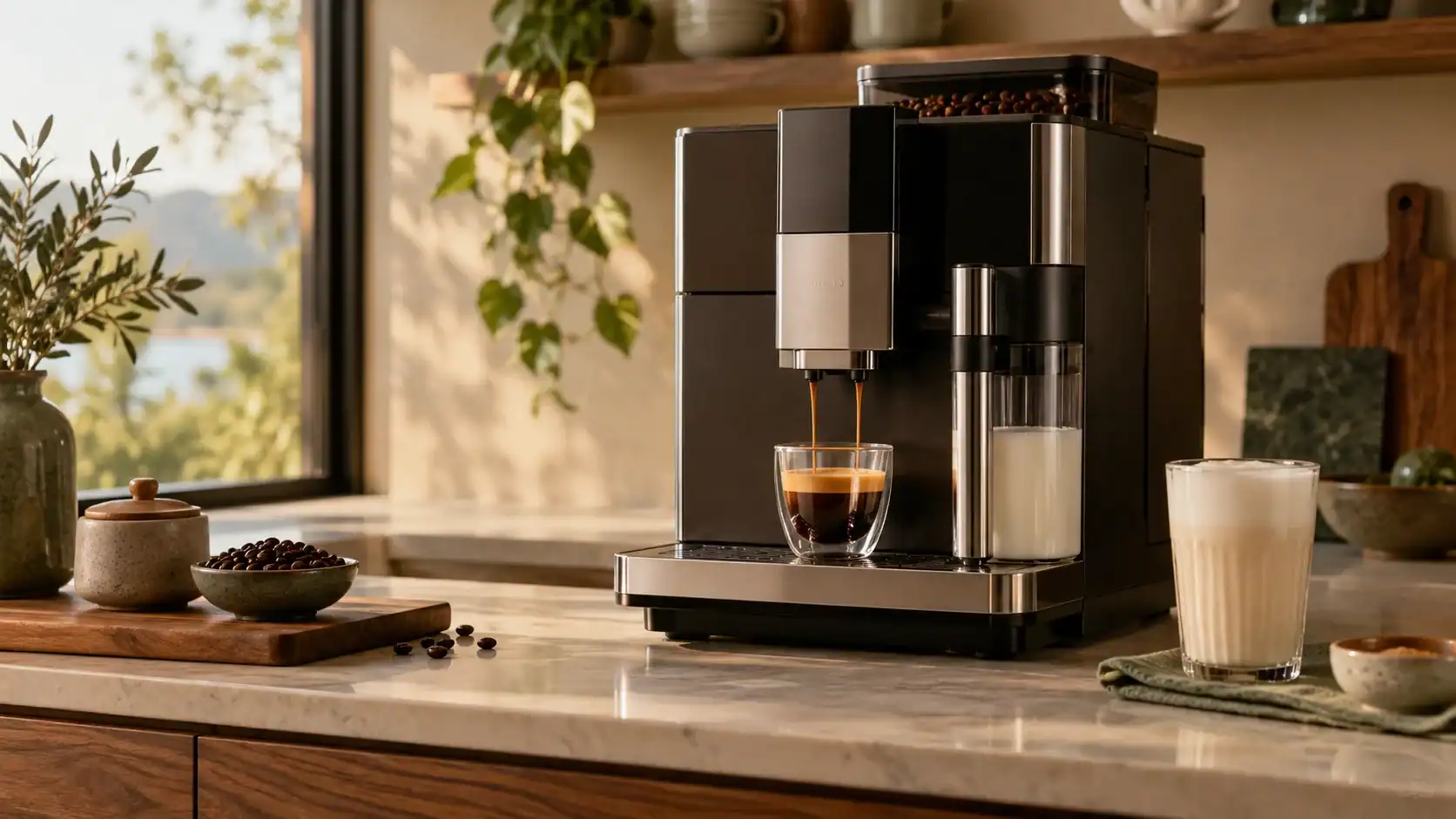
We recommend Jura E4 if you mainly drink espresso or black coffee and want whole beans ground and brewed automatically. We would choose the US E6 Piano Black version discussed here if cappuccino is part of your regular drink choice. The E4’s main compromise is the absence of a milk system; the E6’s is the extra milk handling and cleaning that comes with adding one.
That choice is more useful than beginning with the highest model number or the longest drink menu. Both machines can handle the grinding and coffee preparation inside the appliance. The decision is whether milk assistance will earn its place in your kitchen, and whether you want the E6’s display and additional strength selections alongside it.
E4 is our black-coffee starting point
Its simpler drink selection avoids buying milk features you will not use. The US Piano Black E4 needs the appropriate electrical supply; a milk frother is a separate purchase.
E4 focuses on espresso, coffee, their double selections and hot water. Its built-in grinder means you add whole beans instead of preparing a separate portafilter for each serving. We would choose it if that is the convenience you want and milk drinks are not a regular requirement. You avoid maintaining an attached milk pathway you would rarely use.
The symbol display and three coffee-strength levels keep the controls relatively simple. You can set a preferred coffee-water quantity, so simple does not mean accepting only one serving choice. We would favor that arrangement when you want a familiar coffee selection without navigating a large list of named milk drinks.
E4 prepares its double coffee products in two cycles. That is relevant if two people want coffee together: a double selection does not mean two independent grinders or two different beans brewed simultaneously. It is useful automation of the preparation, while both servings still come from the same bean supply.
E6 adds cappuccino, with a prompted switch
It draws milk through a tube and uses a prompted switch during preparation, so you gain milk assistance with additional cleaning and handling. This is the US E6 Piano Black 15622; other E6 generations can have different milk-system parts.
The E6 version here is the US Piano Black model 15622, identified as NAC. It adds an Easy Cappuccino milk system and a 2.8-inch color display with buttons. We would choose it when cappuccino is a recurring part of your coffee purchase, rather than an occasional idea that leaves the milk equipment unused.
Its milk pipe connects to a suitable milk container or cooler. During cappuccino preparation, the machine prompts you to open a switch for milk foam and close it before the coffee continues. That is important to the recommendation: it helps with preparing the drink, but it is not a one-press sequence that you can assume needs no further interaction.
The E6 also offers ten coffee-strength levels, compared with E4’s three, and a broader selection including cappuccino and macchiato. We would value the additional adjustment if you want more steps between preferred strengths. More choices do not establish that the coffee will taste better to you, so we would still make milk preference the first decision.
The similar capacity means milk is the bigger difference
Both models have a 1.9-liter water tank and a bean container holding about 280 grams. We would not move from E4 to this E6 expecting a much larger supply of beans or water. The capacities are similar; the milk system and controls change the ownership more than a reservoir-size comparison does.
A water tank also supplies the prescribed rinsing as well as your drink. We would leave room in expectations for that water use, rather than calculate a precise number of mugs by dividing the full capacity by a cup size. Large drinks use more water, and milk preparation adds its own care sequence.
Their stated dimensions are about 11 inches wide, 13.8 inches high and 17.6 inches deep. The depth is easy to underestimate in a front-facing product image. Allow working access to fill the tank and bean container and remove the tray and grounds container. On E6, make room beside the machine for the connected milk supply as well.
Automatic brewing leaves routine tasks in your hands
You still supply beans and water, empty used grounds and the drip tray, and respond to the cleaning and filter prompts. We would buy either machine to automate coffee preparation, not to remove every task around it. A larger drink menu cannot compensate if you dislike caring for the appliance that makes those drinks.
The milk system is where the E6 adds the most work. Its instructions call for rinsing after milk preparation and daily cleaning of the fine-foam frother when milk has been used. That is separate from the coffee-system cleaning program. We would accept those tasks for regular cappuccino, while choosing E4 if they would mainly support a drink you seldom make.
E4 still needs its own prescribed coffee and water-system care. Removing milk from the decision makes ownership simpler in one specific way, rather than turning E4 into a machine without maintenance. Keep the appropriate cleaning supplies and filter or descaling arrangements in the purchase plan for the exact model.
Choose coffee that belongs in the bean container
Both manuals specify roasted, untreated beans for the hopper. Ground coffee, freeze-dried coffee and beans treated with additives do not belong there. That restriction matters when a bag’s name sounds like a dessert drink. A machine with an integrated grinder still needs coffee suited to that grinder and the instructions supplied with it.
Our Classico and Super Crema comparison explains two unflavored whole-bean options and the difference between tasting notes and added flavoring. We would begin with a modest quantity of a coffee that suits your preference and the machine’s requirements, rather than assume every espresso-labeled bag is identical.
If you want an occasional different ground coffee, use only the designated ground-coffee facility and sequence described for the exact version. Do not put it into the bean hopper. The existence of that option does not turn the single bean container into two independent bean supplies for different household preferences.
Buy the version whose preparation you actually want
E4 and E6 names have been used alongside different finishes and generations. The E6 comparison here is specifically the US NAC model, with the prompted cappuccino switch and milk system described above.
Optional connectivity and extra accessories should also be checked separately. We would not choose either mainly because an app or matching milk cooler appears in a photograph. The everyday decision is the drink you want and the parts you are happy to maintain. A clear coffee-only preference makes E4 a deliberate choice, not merely a smaller menu to move beyond.
Our recommendation
Choose E4 for automatic black coffee with a simple interface and no attached milk system. We would choose E6 NAC when cappuccino and its additional controls justify the milk preparation and cleaning. The electrical version and supplied equipment are part of choosing either US machine.
As an Amazon Associate I earn from qualifying purchases.