
Reviewed and updated: November 9, 2026
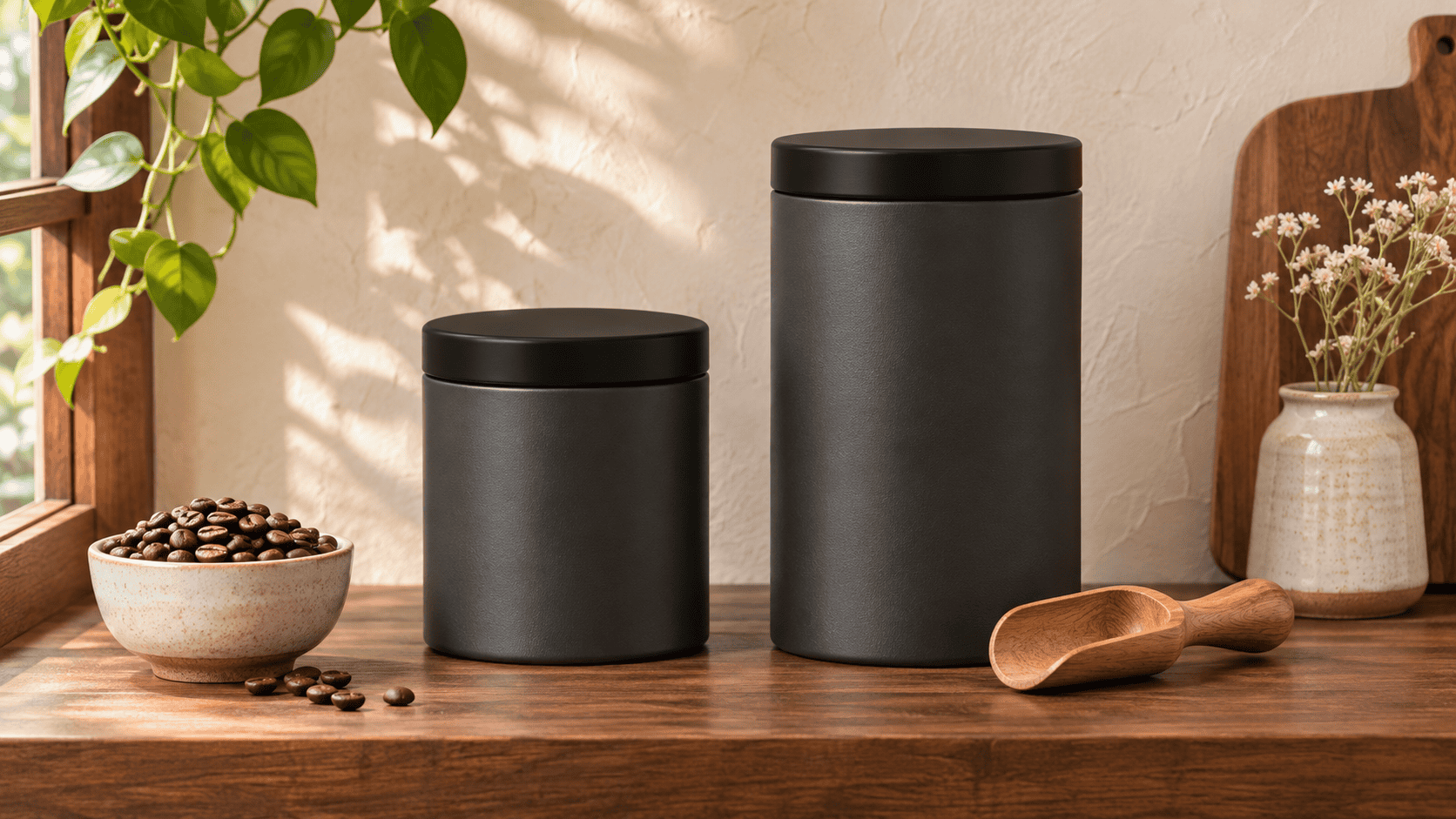
Choose the manual Fellow Atmos 0.7 L when you buy smaller amounts of whole-bean coffee and want a canister that suits that habit. Choose the 1.2 L when you need more room for a larger bag. The bigger size is not automatically the better purchase: capacity, the coffee you actually buy and your willingness to operate the vacuum lid matter more than matching a countertop photograph.
This comparison uses Fellow’s current product information and care guidance, not hands-on testing. It covers the manual twist-to-lock Atmos in two sizes, rather than the Electric Atmos. Both are storage tools. Neither replaces buying a sensible amount of coffee or keeping track of when a bag was opened.
Start with the bag, not the litre number
Fellow lists the 0.7 L canister for up to 11 ounces of beans. Its 1.2 L listing gives up to 16 ounces of light or medium roasts, with an explicit warning that a full pound of dark roast will not fit. Those are more useful buying boundaries than assuming a litre measurement converts into the same coffee weight every time.
The practical consequence is straightforward. Do not choose the smaller size expecting to empty a new 12-ounce bag into it. Do not choose the larger one expecting every pound bag to fit regardless of roast. Compare the stated limit with the exact coffee and pack size you buy; leave yourself an alternative if your beans occupy more space than expected.
0.7 L: a deliberate choice for smaller purchases
The smaller canister makes sense when you usually buy modest amounts, rotate coffees or want separate storage for regular and decaf beans. It can help organize a limited quantity without dedicating a larger container to it. Its limitation is the amount you can transfer at once, which becomes obvious if your normal bag exceeds its stated capacity.
Fellow Atmos Manual Vacuum Canister 0.7 L
Choose it for smaller whole-bean purchases within the stated capacity of up to 11 ounces. Skip it if you want to transfer a new 12-ounce bag without keeping a separate portion.
Skip the 0.7 L if you dislike keeping a partly filled original bag beside the canister. Splitting one purchase across two places makes it easier to forget which portion is older. A smaller vessel is useful only when its size fits the job you intend it to do, rather than requiring a workaround with every refill.
1.2 L: more room, with a roast-dependent limit
The larger option suits someone who buys a larger bag and wants to keep that coffee together. It is the more practical candidate for the light or medium roast pound-bag use case described by Fellow. That extra room is a capacity decision; it does not establish a stronger vacuum or a guaranteed difference in how your coffee tastes.
Fellow Atmos Manual Vacuum Canister 1.2 L
Choose it for more storage room and Fellow’s stated capacity of up to 16 ounces of light or medium roast beans. Skip it if you need a full pound of dark roast to fit.
Skip it if your purchases are consistently small and the larger container merely takes up space. It also does not solve the full-pound dark-roast exception. For a shared household, discuss which coffee belongs in it before buying: repeatedly mixing different bags would undermine the organization you hoped the canister would provide.
Estimate how quickly you finish the coffee
Before selecting a size, calculate your normal daily dose. As a planning example, 300 grams divided by 20 grams per day gives 15 days; at 40 grams per day it gives 7.5 days. Those figures describe consumption, not a freshness deadline or a measured storage result. They help reveal whether you are buying for a week of coffee or a much longer supply.
Use the dose you really brew, including another person’s drinks, rather than an idealized routine. Our coffee-to-water ratio guide can help establish a repeatable starting dose. The right container should accommodate that purchasing pattern. Buying more beans solely to fill a larger canister is a poor reason to choose it.
The manual lid adds a repeated task
With manual Atmos, twisting the lid operates its vacuum pump; the release button lets air back in before opening. A visual indicator signals the sealed state. This is a different commitment from putting a simple lid back on a jar. If making that small adjustment each time would annoy you, consider whether you want a vacuum mechanism at all.
Fellow’s support guidance describes a seal lasting three to five days, with gradual pressure loss possible. Its product guidance advises twisting again every four to five days to maintain the seal. Treat this as a routine to check, especially when the canister is left untouched. It is not a promise that you can seal a bag once and forget it indefinitely.
Whole beans are a buying requirement
Fellow recommends whole-bean coffee and warns that ground coffee or other fine substances may clog the intake valve and prevent a proper seal. If you buy pre-ground coffee, neither of these sizes is the right answer to that storage need. Changing the container volume does not change the mechanism’s restriction.
That distinction matters in homes where people use different coffee formats. Avoid choosing an Atmos for a shared shelf without deciding what will go inside it. Keep the product’s intended contents clear, and do not assume that a storage accessory suitable for whole beans will also suit every powder or small kitchen ingredient.
Cleaning deserves space in the decision
Neither size is dishwasher safe. Fellow says to keep liquid out of the lid and not clean it under running water, using a damp, non-abrasive sponge instead. The canister also needs gentle hand washing. Follow the exact supplied guidance, including the separate treatment of removable parts, rather than washing the lid like an ordinary jar top.
This makes the Atmos less appealing if your priority is equipment that all goes into the dishwasher after use. The manual mechanism needs care as well as operation. A canister that looks convenient on the shelf can still be an inconvenient purchase if its cleanup does not fit the way your kitchen works.
Keep expectations narrower than the marketing
This guide does not assign either size a number of extra fresh days or claim that stored beans tasted better in our kitchen. The useful comparison is fit: bag capacity, operation and maintenance. Keep the opening date and coffee identity accessible so the canister does not become an anonymous supply that is continually topped up.
Our guide to useful coffee notes explains how to record that context alongside a recipe. Keep different coffees identifiable and finish an older portion deliberately before introducing another. A storage purchase can support an organized routine, but it cannot make that routine for you.
Check the lid type and size in search results
Each Amazon action opens a search for the named manual Atmos size, not a guaranteed exact listing. Check that the selected result includes a complete canister and the manual lid, with the intended capacity and finish. Electric lids, replacement lids and bundles are separate purchase decisions; a similar photograph is not enough to establish what you will receive.
Choose 0.7 L for smaller whole-bean purchases within its capacity. Choose 1.2 L for the larger light or medium roast bag use case, remembering the dark-roast limitation. Skip both for ground coffee or dishwasher-first cleanup. A useful purchase fits the coffee you buy and the tasks you will actually repeat.
As an Amazon Associate I earn from qualifying purchases.