
Reviewed and updated: November 9, 2026
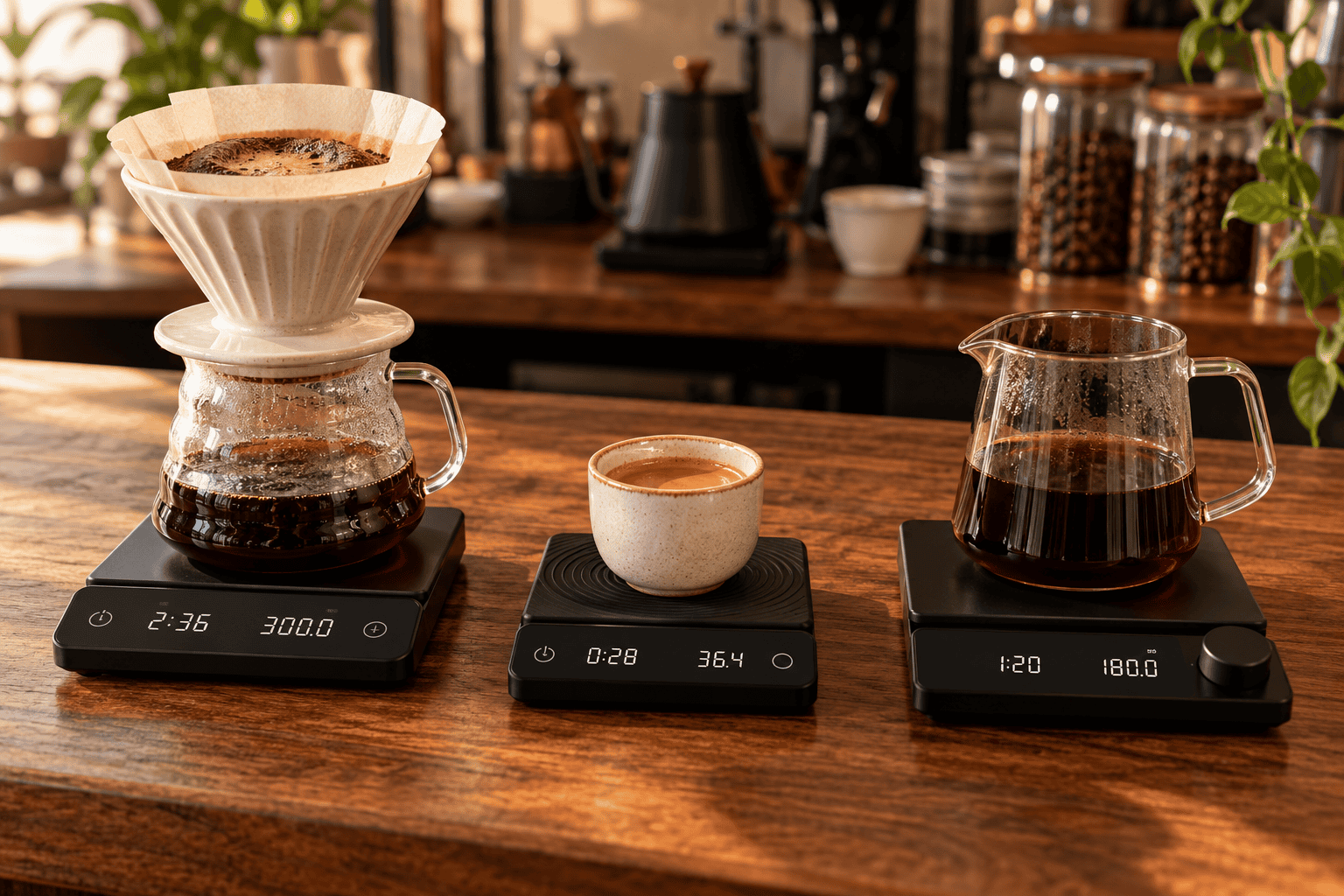
We recommend the Hario V60 Drip Scale when you want weight and time beside a pour-over without adding a menu of brewing modes. Choose the Fellow Tally Pro when a calculated water target would make your daily recipe easier. For espresso, we’d start with the Acaia Lunar’s compact shape and machine clearance rather than try to squeeze a larger pour-over scale onto the drip tray.
These are different purchases for different stations. A useful scale lets you see the measurement while the brewer is in place, accommodates the complete load and has controls you want to use every morning. We’d buy for that ordinary experience before paying attention to extra decimal places. The most elaborate display isn’t much help beneath a carafe that hides it.
Hario V60: our straightforward pour-over choice
The Hario puts a timer and weighing display in a 120 by 190 mm body, 29 mm high. We’d choose it for a manual brewer on a countertop where a server can sit securely and the display remains visible. The separate timing function means you don’t have to balance a phone beside the kettle just to follow the duration of your pour.
Its important compromise is changing resolution across the weighing range. Hario specifies 0.1 g intervals from 2 to 200 g, 0.5 g from 200 to 500 g, and 1 g from 500 to 2,000 g. It is a sensible option for ordinary pour-over recipes, as long as you don’t expect the same fine display increments under every load. Maximum capacity and the smallest displayed increment describe different things.
The scale has an ABS resin body, comes with batteries and isn’t water resistant. That makes it a better fit for a station you can keep dry than a drip tray regularly exposed to spills. We would choose another format if the surrounding wet environment is unavoidable. For a familiar countertop recipe, however, its focused timer-and-weight arrangement may be all the interface you actually want.
Tally Pro: our choice for a calculated water target
Tally Pro’s main reason to join your shortlist is Brew Assist. You choose a ratio, weigh your coffee and receive a target water weight. We’d value that when you change the amount you brew and don’t want to calculate a new target separately. It supports a decision you already make in the recipe; it doesn’t select the coffee or decide which ratio you will enjoy.
If you prefer to remember your own target, Timer mode shows weight in grams beside elapsed time. Weight mode offers ordinary weighing in several units, including grams and ounces. Those choices make it possible to keep using the scale without turning every coffee into a guided exercise. We’d consider that flexibility more useful than buying assistance you can’t conveniently set aside.
The 2,500 g maximum provides more total capacity than the other two choices here. It can matter if your server and brewer are heavy before the coffee and water arrive. USB-C recharging is another difference from the battery-powered Hario. We’d choose Tally because its ratio feature and format suit the counter, rather than as an automatic upgrade for someone whose existing timer and scale already work comfortably.
Acaia Lunar: our espresso-focused recommendation
The Lunar’s 105 by 105 mm footprint and 15 mm height make physical fit central to its appeal. We’d compare that shape with the usable drip tray, the cup and the clearance beneath the portafilter. A small scale can still be unsuitable if it bridges an edge or lets the cup touch the machine. Those contact points matter more to the purchase than choosing the finish that matches the grinder.
The current Lunar offers automated timing modes, a flow indicator and Tare Save for a preferred container. We’d choose those features when espresso is a regular part of your routine and you want to refine how the scale behaves around the cup. If you just want to watch weight and press a timer, decide whether you want to learn those additional settings before choosing it.
Its 2,000 g capacity, USB-C charging and supplied heat-resistant pad belong with this version’s specifications. Water resistance is useful around espresso, but doesn’t make it a washable appliance. Keep charging connections dry and use the supplied heat protection as directed. We wouldn’t buy a Lunar to gain a large pour-over platform; its attraction here is fitting the espresso task into a small space.
Choose the scale around the complete load
The vessel, brewer, coffee and water all contribute to the physical load. Taring the display doesn’t remove the weight already on the platform. If you favor a substantial glass server, leave room in the capacity calculation for the coffee you will add. That is a reason to consider Tally’s extra headroom, even if the finished drink itself seems modest. When also choosing a pour-over decanter, compare its assembled base and weight with the platform rather than looking only at its drink capacity.
Also look at the display from your normal position. A wide brewer base or an overhanging handle can make a sensible specification awkward in use. We’d prefer a clear view of ordinary numbers to a crowded arrangement that forces you to lean around the server. Espresso buyers should include the cup handle and drip-tray edges in that same decision.
Pay for the controls you’ll use
A built-in timer is convenient when it keeps your attention on the brew. Ratio calculation is useful when it replaces arithmetic you routinely perform. Automated espresso modes are valuable when they match how you handle the cup. We’d choose among those benefits deliberately instead of treating them as a ladder that every home brewer must climb.
If your kitchen scale already fits, gives useful coffee measurements and works alongside a separate timer, you may not need to replace it. A dedicated model earns its place by removing an actual annoyance. Spend on visibility, suitable capacity or a more comfortable routine before assuming an additional display digit will transform the cup.
Which would we buy?
Choose Hario for straightforward countertop timing and weighing, Tally Pro for ratio assistance and greater load headroom, or Lunar for a compact espresso station. We’d settle physical fit first, then choose the controls that simplify the coffee you actually make. There is little benefit in a specialized scale that doesn’t fit where you brew.
Use the care instructions for the complete current scale model. A suitable scale should make measuring feel routine, leaving you free to decide what tastes good in the cup.
As an Amazon Associate I earn from qualifying purchases.