
Reviewed and updated: November 9, 2026
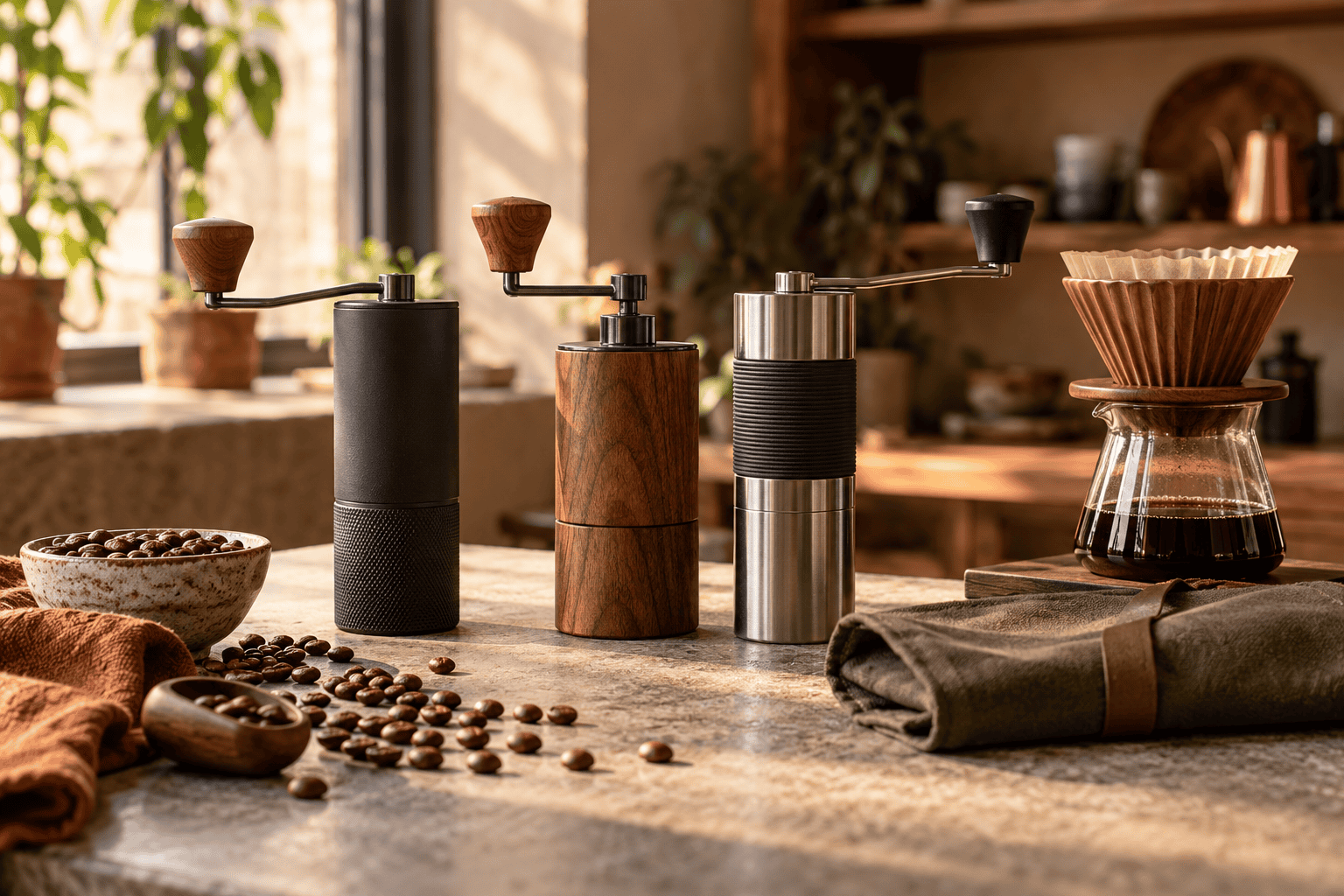
We’d choose the TIMEMORE Chestnut C3S for a small everyday coffee station when you want a metal hand grinder and your usual dose fits its 20 g capacity. We’d compare the 1Zpresso Q Air when a lighter kit and plastic body suit you, or the Hario Mini-Slim Plus when you prefer ceramic burrs and a transparent collecting cup. All three replace a powered countertop appliance with a manual task.
That trade is the reason to buy carefully. You gain equipment that can return to a cupboard after brewing, but you supply the grinding effort each time. We recommend a hand grinder for a modest routine that you are happy to prepare manually. If several people need coffee together or cranking is uncomfortable, a compact electric grinder may be the more useful use of your space.
C3S: our choice for a small everyday station
The standard C3S combines 38 mm stainless steel burrs, a metal construction and an internal adjustment dial. We’d choose it when you mainly want a familiar single-cup grinder that doesn’t need a permanent outlet. You can put it with the brewer and papers between uses instead of leaving a separate powered base on the counter.
The standard handle is an important distinction from the Pro version’s folding arrangement. If the grinder will live in a kitchen drawer, consider the packed shape you need rather than assume every C3 variant folds. You may find the standard version entirely suitable when a folding arm would add little benefit. We would choose that feature deliberately if it solves an actual storage problem.
Its 20 g capacity is also worth treating as a practical limit rather than a serving promise. A small coffee and a large shared brew don’t require the same dose. If your normal recipe is larger, repeated filling and grinding can make a seemingly convenient purchase feel cumbersome. We’d choose another capacity before asking a small grinder to handle that routine every day.
Q Air: our alternative when reducing kit weight matters
The Q Air uses steel burrs in a small grinder with a polycarbonate body and collecting cup. That material choice is a meaningful alternative to an all-metal format. We’d consider it when you carry the kit between places or prefer to keep the grinder’s weight down. We’d choose the C3S when the metal construction is the feature you particularly want for a home station.
The Q Air’s 15–20 g capacity keeps it in the single-serving discussion. It isn’t the answer to a household that has outgrown small batches. It is another way to make a compact manual setup, with a different material and handling preference. If the dose already fits, those everyday details can matter more than choosing a grinder that looks more substantial in a photograph.
Its handle doesn’t share the Q2 S’s folding design. A Q-family name isn’t a reason to combine features from different models, so match the actual Q Air before choosing. The included anti-slip band can be useful to consider as part of the grip arrangement, while your own hand comfort remains a better guide than assuming every narrow grinder will suit everyone equally.
Mini-Slim Plus: ceramic burrs and a visible grounds cup
The Hario provides a different material combination: ceramic burrs with a clear resin collecting container and plastic body components. We’d consider it if that visible collecting cup and ceramic grinding assembly are features you prefer. The transparent container lets you see the grounds, though it doesn’t replace measuring the amount your recipe needs.
The stated 24 g grounds capacity refers to the collecting side. We’d avoid treating it as a directly comparable bean-hopper number alongside the other two grinders. What matters is whether your actual dose can be prepared conveniently in the intended way. Product capacity labels can describe different parts of the process, even when each one is expressed in grams.
The Mini-Slim Plus is the MSS-1DTB, distinct from other Mini-Slim versions. Its assembled dimensions include the handle, so think about the complete packed arrangement rather than just the width of the central body. If you take the grinder away from home occasionally, keep the removable pieces together so storage convenience doesn’t become a search for a missing part before brewing.
Small-kitchen convenience is about putting the kit away
A hand grinder can make sense when the same counter serves as your cooking and coffee space. You can bring out the brewer and grinder, make coffee and return the equipment to a shelf. We’d value that arrangement when you brew one small serving at a time. The saving comes from avoiding a permanent appliance position, rather than from pretending manual preparation takes no room.
You still need somewhere stable to fill the grinder and transfer the grounds. A collecting cup that is awkward for your brewer can add work even when the grinder stores neatly. Consider how the ground coffee will reach your filter, press or basket. The right grinder should be comfortable for that small repeated movement as well as easy to fit into a cupboard.
Adjustment and care should remain manageable
These compact grinders suit you best when a familiar manual brew is the main job. Internal adjustment is less accessible than a visible external dial, but can be perfectly practical when you keep a useful starting setting. A large click count isn’t a universal measure of better control, because different mechanisms move the burrs by different amounts.
We’d be more selective for an espresso-led setup, where fine adjustment and repeated doses become central to the purchase. The fact that a grinder can produce fine grounds doesn’t settle how well its controls fit that task. Choose around the drink you make most often rather than a broad range claim that encourages you to expect one small grinder to be equally convenient for everything.
Care is another part of choosing a compact kit. Follow the exact cleaning and reassembly instructions; don’t assume a small grinder is washable. The Q-series guidance calls for dry brushing rather than soaking. If you dislike handling small components, favor a routine you are comfortable maintaining instead of buying a grinder whose main attraction is disappearing into a drawer.
Which would we choose?
We recommend the C3S for a small everyday station built around its metal format and a suitable single-cup dose. Compare Q Air when carrying weight and a plastic body make sense, and Mini-Slim Plus when you prefer its ceramic burrs and visible cup. Choose electric grinding instead if repeated hand effort is the problem you want the purchase to remove.
The best small-kitchen choice is the one that stores comfortably and still feels worth using when it comes back onto the counter every morning.
As an Amazon Associate I earn from qualifying purchases.