
Reviewed and updated: November 6, 2026
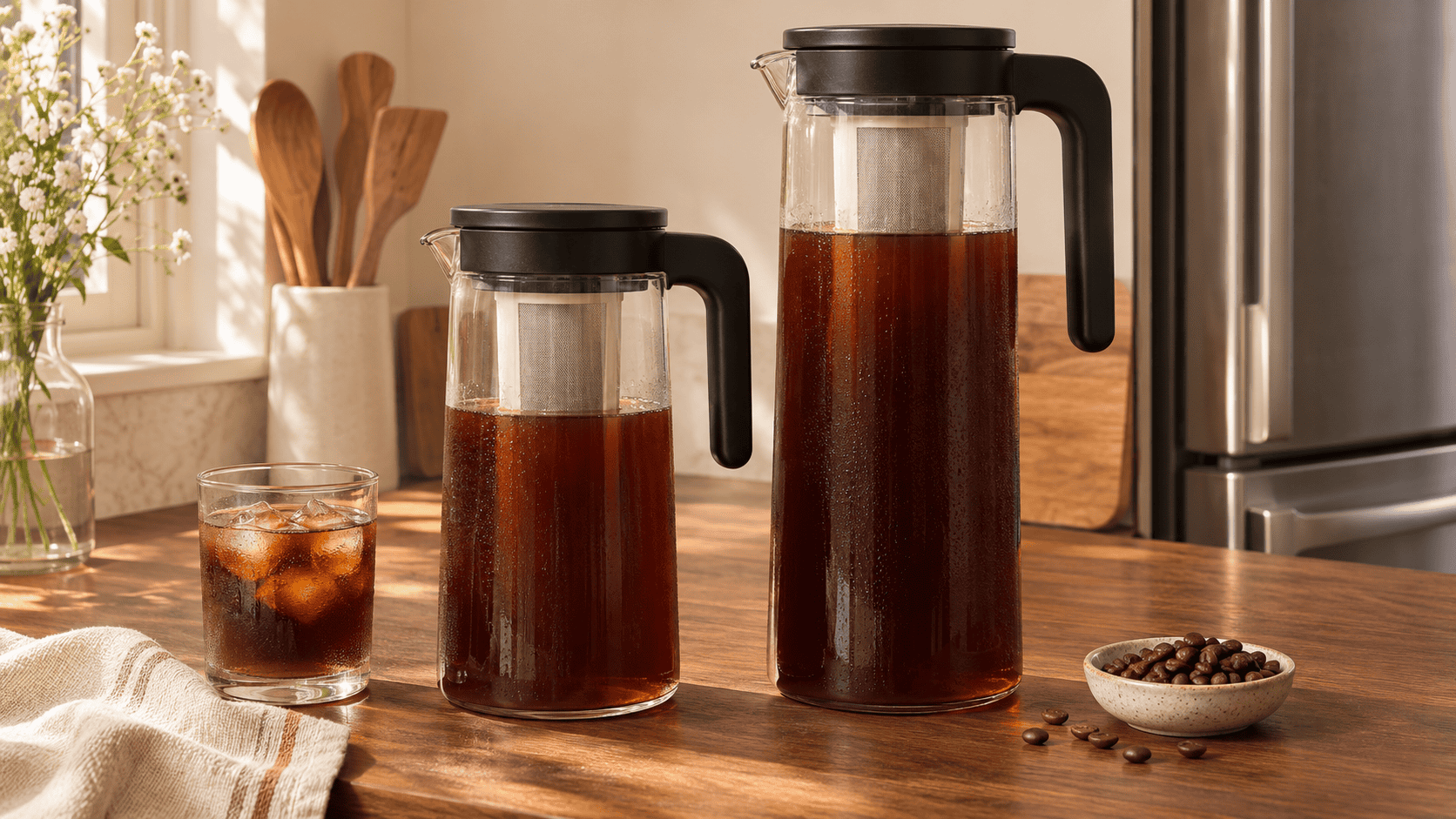
Choose the 600 mL Hario Mizudashi when you want a smaller cold brew batch and have limited shelf height. Choose the 1,000 mL version when you regularly pour enough coffee to justify the taller pot. Both use the same basic approach: ground coffee sits in a mesh basket while the pot brews in the refrigerator. Size, rather than a different brewing technology, is the reason to pick one over the other.
This buying comparison uses Hario’s published product information, not hands-on testing. It compares the MCPN-7 family with the MCPN-14 family. Match the capacity and full model description when shopping, since color suffixes and regional product codes can differ.
Start with the coffee you actually drink
Hario specifies brewed volumes of 600 mL and 1,000 mL. Think in milliliters before thinking in cups: the manufacturer’s small cup counts do not describe a large iced-coffee glass. Ice, milk and dilution also change how much brewed coffee you pour into each drink. Measure your usual coffee portion separately from those additions.
For example, a 200 mL portion divides those nominal volumes into three or five portions. That is planning arithmetic, not a guarantee of exact yield from any recipe. Grounds retain water, and your preparation affects the result. If you usually want only one modest serving at a time, a bigger batch is useful only if you actually intend to drink it.
Choose 600 mL for a smaller routine
The MCPN-7 is the better starting point for one coffee drinker who prefers making smaller batches. Hario USA lists its dimensions as 138 mm wide, 94 mm deep and 208 mm high. Its shorter height is a practical advantage when a fridge shelf sits low, although you still need room to lift and remove it.
Skip this size when two people regularly empty the pot quickly or your daily serving is unusually large. Repeating the preparation more often may matter more than saving vertical space. The smaller model also does not mean half the footprint: compare the stated dimensions rather than assuming every measurement shrinks with capacity.
Hario Mizudashi 600 mL MCPN-7
Choose the shorter 600 mL pot for smaller batches and lower fridge shelves. Skip it if your household regularly needs a larger batch.
Hario Mizudashi 1,000 mL MCPN-14
Choose the taller 1,000 mL pot for a larger shared batch. Skip it if 294 mm height will not fit your refrigerator shelf.
The MCPN-14 suits a household that wants a larger prepared batch without moving to a different type of cold brewer. It holds a stated 1,000 mL brewed volume. That extra capacity is useful when it meets a real serving need; it does not establish that the resulting coffee will taste better than coffee from the smaller pot.
Hario USA lists 138 mm width and 94 mm depth for this version too, but its height rises to 294 mm. The important space tradeoff is therefore vertical. A shelf that accepts the smaller pot may reject the larger one. Measure the clear space above the shelf, including obstructions near the front where you pull the handle toward you.
Check fridge fit before choosing capacity
A claimed fit in someone else’s refrigerator says little about yours. Check shelf clearance, the usable shelf depth and the space around the handle. Door bins can have rails, curved edges or a bottle shelf above them. Do not buy the tall version on the assumption that a slim glass body automatically makes it a suitable door-bin container.
Consider where the pot will sit while you fill and clean it as well. A taller vessel needs a clear landing spot beside the sink and room under nearby cabinets. If moving the larger pot requires rearranging groceries every time, the smaller version may fit your routine better even if its capacity looks less generous on paper.
The mesh basket is part of the decision
Both versions use a removable strainer rather than a disposable paper filter as their central brewing component. That makes them worth considering if you want a dedicated pitcher and basket together. It also means the basket needs cleaning after brewing. A reusable part changes the work involved; it does not remove the work.
Hario describes the mesh as polyester resin, with polypropylene used for the lid, strainer frame and handle band. The pot is heatproof glass, and the bushing is silicone rubber. Neither model is an all-glass brewing system. If avoiding plastic components is a firm requirement, choose a different design instead of assuming a glass pitcher meets it.
Buy for refrigerated steeping, not instant coffee
Hario’s guidance describes wetting the coffee with water and refrigerating the prepared pot for approximately eight hours. That makes this a planned-ahead method. Choose either model when you can prepare coffee before you need it; skip both if your main problem is wanting a cold drink immediately with no preparation the night before.
The pot does not grind beans, weigh coffee or control the recipe for you. Hario notes that grind choice changes the character of the brew. Start with the instructions supplied for your model, then change one variable at a time. Our guide to useful brew notes can help you record the coffee amount, grind and steeping time without relying on memory.
Expect cleanup to shape daily use
A removable basket is useful only if you are happy to empty and rinse it. Think about how you will dispose of wet grounds and where the parts can dry. Follow the model’s care instructions, inspect the glass before use and handle it carefully around a hard sink. Heatproof glass still deserves deliberate handling.
Do not select the larger version solely to postpone cleaning. Choose a batch size that matches consumption and your willingness to prepare the next batch. If your present jar-and-filter arrangement already gives you the volume you need, either Mizudashi is an organizational purchase rather than a necessary upgrade. A dedicated pot may simplify your setup, but that benefit depends on your own workflow.
Check the model in the search results
The buttons open precise Amazon searches, not guaranteed exact product listings. Confirm that the selected result describes a complete Mizudashi pot, the intended 600 mL or 1,000 mL capacity, and the relevant MCPN family. Search results can mix colors, replacement parts and accessories. A product photograph alone does not establish package contents.
If you are still deciding whether you want cold steeping at all, our cold brew versus iced coffee guide explains the distinction. Buy the 600 mL model for a smaller batch and lower shelf clearance; buy the 1,000 mL model for a larger shared batch when its height fits. Skip both when glass, reusable mesh or advance preparation would make the routine harder to maintain.
As an Amazon Associate I earn from qualifying purchases.