
Reviewed and updated: November 10, 2026
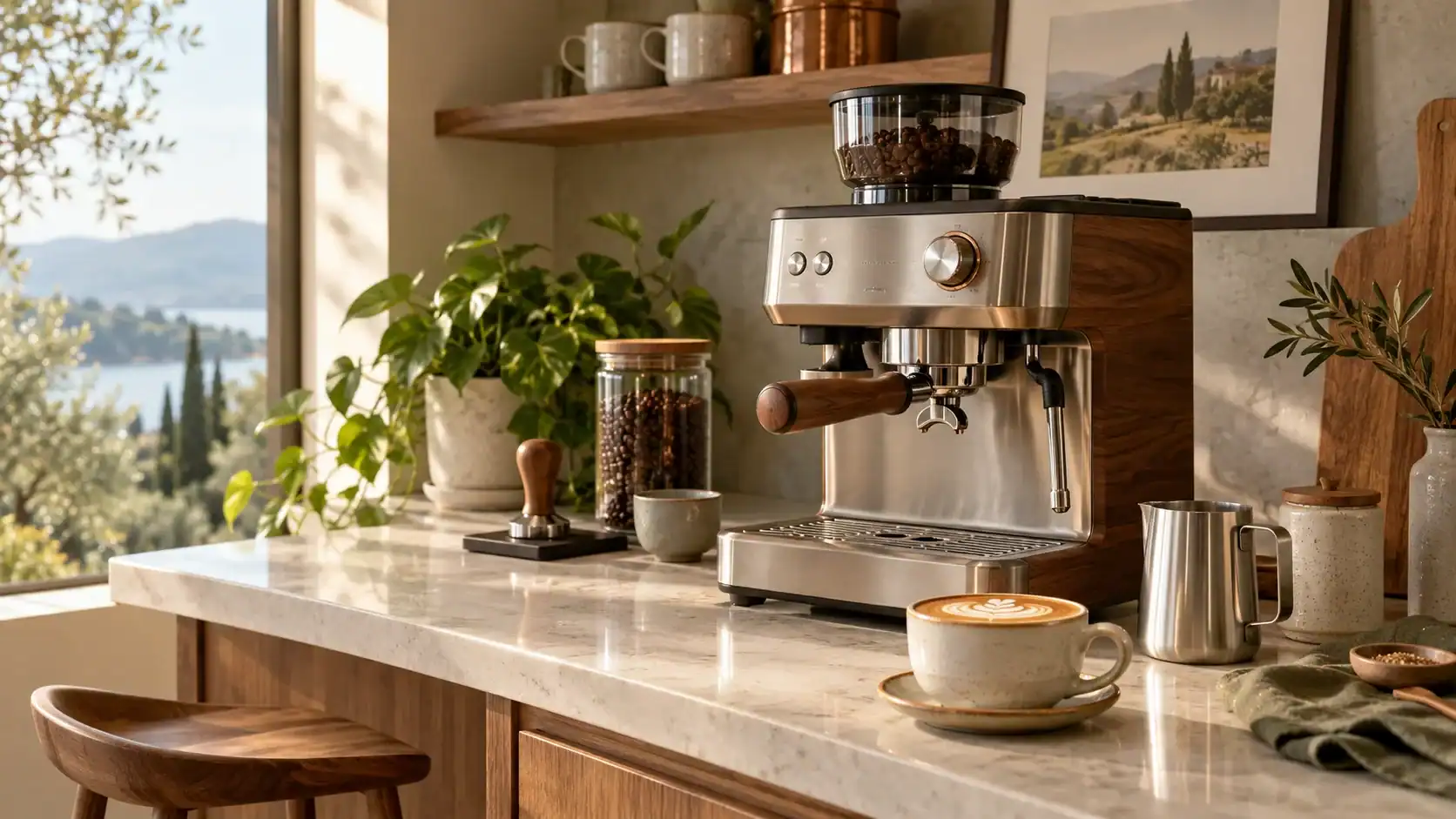
We recommend Breville Barista Express if you want an integrated grinder and enjoy preparing espresso yourself. It brings grinding and brewing into one appliance, but its main compromise is the work left to you: you still adjust the coffee, tamp by hand and steam milk manually. We would choose Barista Express Impress instead if dosing and tamping are the steps you most want help with.
The decision is about how involved you want to be before each shot. Standard Express gives you a conventional portafilter and tamper experience with beans already at the machine. Impress adds preparation assistance while retaining a manual steam wand. Neither turns a button press into a finished latte without your participation.
Standard Express is for a hands-on coffee station
You tamp the grounds and texture milk manually; the built-in grinder does not make this a one-touch latte machine.
The built-in conical burr grinder delivers grounds directly into the portafilter. That keeps your bean supply, grinding control and brewing position together, which is useful when you want one dedicated espresso station. You do not need to select a separate grinder to begin using whole beans, although a scale and space for handling the portafilter can still be useful additions.
Grind size and grind amount are separate decisions. Changing how fine the grounds are is different from changing how much coffee reaches the basket. We would choose Express when you are willing to learn those relationships, rather than expect the machine to determine every adjustment for a new bag. An integrated grinder simplifies the arrangement on the counter; it does not eliminate coffee preparation.
The supplied tamper leaves the pressing step in your hands. That can be appealing if learning the process is part of the reason you want an espresso machine. If you mainly see tamping as a chore between you and a drink, the Impress comparison matters more than the standard machine’s familiar appearance or the number of controls on its front.
Impress helps with the coffee puck, not the milk
We would choose Impress when preparing a consistent coffee puck is the step you want help with. Its dosing feedback and assisted tamping reduce manual preparation decisions, while milk texturing remains manual. Impress is the assisted-tamping version, rather than the standard Barista Express.
Barista Express Impress uses an assisted tamping lever and a dose-level indicator. Its dosing system remembers the previous grind and tamp outcome, then adjusts the next dose. We would choose that help if judging the fill level and applying the tamper are the preparation steps you find least appealing. The portafilter stays in its cradle while you grind, dose and use the assisted tamp.
You still select a grind setting, move the prepared portafilter to the group head and brew the espresso. Assistance makes the preparation more guided; it does not assess every aspect of the drink for you. We would not buy Impress expecting it to remove the need to match the coffee and grind to your preferred result.
Impress also has 25 main grind settings. That is a feature of this specific version, not a reason to treat every Barista Express listing as the same machine. Its most consequential difference for this purchase is the dosing and tamping assistance. If you are already comfortable preparing the basket by hand, that assistance may solve a problem you do not have.
The shared brewing features do useful work quietly
Both machines use a Thermocoil heating system with electronic temperature control. They also begin with low-pressure pre-infusion before espresso extraction. We would value those features as part of a controlled brewing process, while keeping the recommendation grounded in how you prepare coffee. They cannot compensate for every unsuitable grind or dose.
The standard Express gives you single- and double-shot buttons, manual override and programmable shot volumes. That means you can retain a familiar serving selection instead of holding a brew control throughout each shot. A programmed water volume is different from weighing the finished espresso, so we would not mistake the buttons for automatic measurement of everything in your cup.
The pressure gauge provides extraction feedback, but it is not a flavor score. We would choose between Express and Impress around the preparation assistance, rather than expect a gauge position to decide whether you like a particular coffee. Both also provide a dedicated hot-water outlet, useful when you want to lengthen an espresso into an Americano without a separate kettle.
Milk drinks remain a manual commitment
Both versions use a manual steam wand. You hold and position the milk jug, manage texturing and then pour the milk into your cup. We would recommend either when that participation is welcome. If you want automatic milk temperature and texture settings, these two machines are not interchangeable with a model that supplies that assistance.
That distinction becomes more important when most of your drinks contain milk. A grinder built into the machine does not reduce the work of steaming the next jug. For several drinks, you also continue handling used coffee pucks and preparing fresh baskets. We would choose around those repeated steps rather than assume that an all-in-one housing means a fully automatic process.
An integrated grinder is convenient, with an ownership tradeoff
Keeping the grinder and espresso machine together can be tidier than positioning two separate appliances. You need room above the bean hopper and water tank, plus access for the steam wand and jug. Check the usable counter around the machine, not just the space occupied by its base. A nearby wall or shelf can make a technically fitting appliance awkward to use.
The same integration links the two parts of your coffee station. If you later want a different grinder, you can add one, but the original grinder still occupies part of the machine. We would prefer separate equipment if choosing and upgrading the grinder independently is already a priority. Express is most persuasive when its combined arrangement is an advantage you intend to keep.
A scale remains useful even with an integrated grinder. Our coffee-scale guide explains a useful companion for weighing espresso doses and drinks. A scale supports a more deliberate setup whichever machine you choose; it is a separate tool, not a hidden feature of the Express dosing control.
Cleaning is part of the decision
Milk texturing brings immediate wand care: the steam wand needs wiping and purging after use. Coffee preparation also leaves the basket, portafilter, drip tray and grinder to maintain, alongside the prescribed cleaning and descaling cycles. We would accept that ownership effort for the hands-on control, rather than view the integrated grinder as a way to avoid maintenance.
The current Barista Express manual calls for hand washing its parts and accessories. Do not treat a dishwasher-safe accessory description as permission to wash the complete machine. Let hot parts cool as directed, keep the powered housing out of water and never remove the portafilter during pressurized brewing. Follow the instructions for the exact model you select.
Our recommendation
Choose standard Barista Express for an integrated grinder with manual preparation you want to learn and control. We would choose Impress when dosing and tamping assistance would make that same coffee station more inviting. Both retain manual milk texturing. The full model name distinguishes the standard Express from Impress.
As an Amazon Associate I earn from qualifying purchases.